Saturday I went to my friend's housewarming BBQ, which later turned out to be an engagement announcement party. The guy is very settled. Very homely 1 bedroom apartment in Jersey City, domesticated decor, all in all located in a very family-oriented neighborhood.
Experiencing that atmosphere brings plenty of mixed feelings - fear, envy, relief, etc. Fear because for this couple, the game of life is almost over. The guy is content w/ his job, they're happy in their relationship, they could probably die happy just like that. Thinking about that terrifies me, because it represents a death of your restless self into a new immutable self. The envy part is mostly due to the fact that they are living so comfortably and the fact that they are set in life. But then again, is comfort really a good thing?
Showing posts with label life. Show all posts
Showing posts with label life. Show all posts
Monday, June 30, 2008


Tuesday, June 24, 2008
Oneness
Enlightenment is obtained not from differentiating happiness as a positive, sadness as a negative, but rather accepting all the spectrum of life seamlessly as one whole. There is no differentiation but a mix of all the emotions and experiences of life into one, and the acceptance and appreciation of this as reality.
Knowledge and theory is gained from words, but the wisdom of this oneness can only be gained through experiencing every aspect of life.
"Knowledge can be conveyed, but not wisdom. It can be found, it can be lived, it is possible to be carried by it, miracles can be performed with it, but it cannot be expressed in words and taught." ~Siddhartha, Herman Hesse
Knowledge and theory is gained from words, but the wisdom of this oneness can only be gained through experiencing every aspect of life.
Tuesday, March 13, 2007
You can't be good at everything
One of my problems is that I hate to do things that I've realized I suck at. Perhaps the most abhorred activity I can think of in regards to this mentality is skating. I don't think there is anything I suck at more in life than skating, which I'm completely hopeless in. It's not that I haven't actively tried to get better in it. I've gone to the rink probably three times in my life, and surprisingly each time was more disastrous than the previous.
So this leads me to my other dilemma. Whenever I try to "like" something, I feel like I have to be good at it, or understand what it takes to be good at it. But isn't there some life rule that states you can't be good at everything? When I try to like something, I sometimes have to tell myself Yes, it's possible to be good at everything. Otherwise I don't really want to try. Yeah... I know it's bad.
So this leads me to my other dilemma. Whenever I try to "like" something, I feel like I have to be good at it, or understand what it takes to be good at it. But isn't there some life rule that states you can't be good at everything? When I try to like something, I sometimes have to tell myself Yes, it's possible to be good at everything. Otherwise I don't really want to try. Yeah... I know it's bad.
Monday, March 12, 2007
Commitment Reminders and FWYDWYD syndrome
I've learned that whenever you commit to something difficult that involves a great deal of sacrifice, like quitting your job to found an internet startup, you need to constantly remind yourself why you chose your path. This is because, almost always, distractions come by and you lose track of your original motives, and these motives were what drove you to do what you did in the first place, and these motives will always be the strongest.
What I've learned is that the syndrome of forgetting why you're doing what you're doing (FWYDWYD) is all too common, and almost always it creeps up on you without you knowing. You don't just wake up one day and say to yourself "wow, I've forgotten why I'm doing this," FWYDWYD is a lot more dangerous than this. The symptoms are always indirect. You start losing energy, you start doubting more consistently, it becomes harder to pull yourself up in the morning, you feel stressed some days and you can't even explain it. These are symptoms of FWYDWYD and the only way to prevent and squelch them is to constantly remind yourself why you do what you do. As an entrepreneur, I've found the following useful ways to do this:
1) Reliving those days when I started my commitment. Includes reading emails I sent back then, reading articles I had read back then when I was first inspired, getting back in touch with people I was in touch with back then.
2) Writing and communicating the original motives to people. I've learned that whenever I put something into words for me to hear and see, the ideas behind those words liven up and take on new meaning internally.
3) Interact with others who currently have the same motive as you did back then. When I was in China for the Spring Festival, I had the chance to talk with a product developer at a Chinese internet startup. The energy he had and the forcefulness with which he articulated his vision reminded me of how I was like back then, and brought back a lot of fire.
I think that for anyone committing to something great, the fire is always greatest when just starting. And to go back to those days is essential fuel to ensure that the fire doesn't burn out.
Wednesday, March 07, 2007
River Town, Being an Outsider and Why I love to Travel
Four weeks ago on my plane ride to China, I finished Peter Hessler's River Town: Two Years on the Yangtze, a book bought for me by a mentor. The book is Peter's narrative as an American Peace Corps volunteer teaching in Fuling, a remote town in China's Szechuan province. It actually reminded me a lot of my friends Rishi & Paulette who are currently teaching in Japan. Being the first American to live there for so long, he experiences I would say a unique reaction from the Chinese living there, but most importantly he is also able to provide an outsider's perspective on Chinese culture. What happens when you're an outsider? You become more aware, more sensitive to what people accept as day-to-day.
When asked about my childhood, I just say I grew up in China but I lived in America. This means that my childhood experiences are Chinese while my the experiences of my youth are American. I think sometimes this creates a chasm because I've absorbed one culture as a child and absorbed a much different one later on throughout maturity. I believe that childhood memories are more dear to the heart while your adolescent memories determine more the way you live and how your life turns out. Thus when I think of China I think of fondness, of family, and of the past. When I think of America I think of life, career, and future. But moving on, reading this book shocked me because I feel like I identify with the author, who provides an outsider's perspective. Yet, on the flip side, I remember reading a Chinese narrative of life in America and I identify with that too. I don't know if others who've lived a similar life go through this as well, but I feel like I'm always an outsider who is constantly more or less observing a lifestyle rather than living it. I think this is why I'm in love with traveling. Traveling allows me to be myself and shows me that it's okay to be an outsider, because travelers will always be one. This is also why the only people I will ever truly get along with are travelers themselves because they know what it's like, and thus appreciate, to be on the outside.
Sometimes every now and then I do wish I could have been born and had stayed in one place, so I could know what it's like to truly fit in with a normal person's lifestyle. But I know that for the most part I don't think I would have had it any other way. I enjoy the open-mindedness that comes from being dual-cultured and I appreciate how it has made me adaptive to change.
Anyhoo, I'll post up some of my favorite excerpts from the book later. I think you'll enjoy them :)
Sunday, March 04, 2007
Overachieving
Some thoughts of mine on Alexandra Robbin's recent article Confessions of a (Recovering) Overachiever featured in Forbes...
It may sound obvious, but it's very easy to denounce the over-achieving life when you yourself have gone through it. But to further explain... Robbins talks about the pressure to succeed. Most would agree that this pressure comes mainly from external factors like peer pressure. You want to succeed so you can look good to others, have something to feel good about. But it's cheap to cry out against the negatives of overachievement when you already have those trophies up to show people. It's so easy to live the easy, non-over-achieving life when you already have those safeguards in the arsenal that you can quickly pull out at anytime to show people that you've had great success in life, and thus make yourself feel better.
I also believe that it's easy to appreciate the easy life when you've gone through the pressured life. It's the old argument against "ignorance is bliss." Enlightened people are the only ones who know how to appreciate the so-called bliss that the ignorant ones are living. So I think one can make the alternative argument that if you've been living the easy way all your life, then you should give stress a try and push yourself to the limits, see how far you can go. I don't think you can fully enjoy doing what you love until you've experienced what it's like to do what you hate.
I know what Robbins is trying to do, and I appreciate her current life mission. I just feel that the other side to her argument should not be overlooked.
Friday, September 29, 2006
Relentless
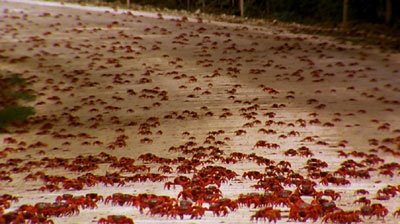
Every year around nov/dec, millions of red crabs migrate to the beach where they hook up, breed, release their eggs into the ocean. Their migration can last up to 18 days. It's long, perilous, and spectacular. What impresses me the most, however, about their journey is the relentlessness. Along the way they get gobbled up by birds, squashed by cars, but they stay consistent on their path; i.e. after running across a road frogger-ing its way across, one of them will rest for a bit, collect its breath, and move on. Sure you can downplay all this by pointing at their frontal-loblessness, but even in the wild you'll see animals place their own survival above all; mothers will ditch their young (or even eat them) just to live on. But these guys will risk their own life & limb to extend their race, stopping at nothing.
Subscribe to:
Posts (Atom)